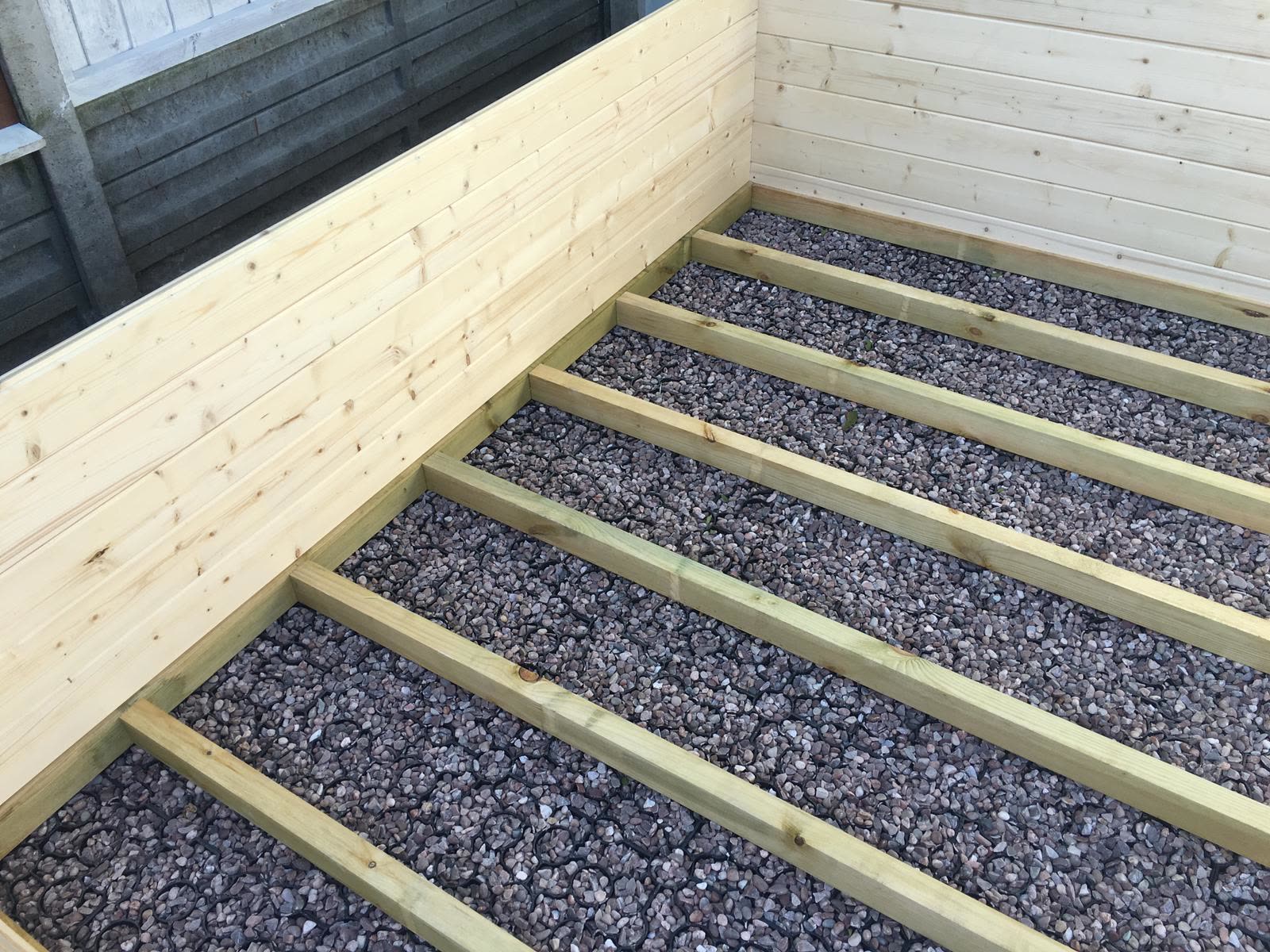

Is gravel right for your shed?
Gravel drains. Rain runs straight through it instead of pooling under the floor, which is what rots most timber sheds from the bottom up. It's also forgiving: you don't need to mix concrete, and if you move house or move the shed, the gravel can be raked flat or reused.
Good fit
- Timber sheds up to about 10×8 ft
- Firm or slightly sloping ground
- A budget under £250 for the base
- Gardens where the shed may move one day
Think again
- Log cabins, workshops with heavy machines, or anything over 10×12 ft: use paving slabs or concrete
- A slope of more than about 150 mm across the base
- Ground that floods and stays wet for days
Materials and quantities
Put in your shed's floor size (the size it's sold as) and this works out the base and the shopping list. The base runs 150 mm wider than the shed on every side so rain dripping off the walls lands on gravel, not soil. Tick things off as you buy them; the list remembers on this device.
75 mm of gravel suits most sheds; 100 mm if it will hold a mower and heavy tools. Soft ground means clay, wet or recently dug soil.
- Base size
- 2.74 × 2.13 m
- Area
- 5.8 m²
- Materials
- £142–£235
Tools
- Spade and a rake
- Tape measure, string line and four pegs
- Spirit level (1.2 m) and a straight timber edge
- Hand saw or circular saw
- Drill-driver
- Staple gun
- Hand tamper, or a hired plate compactor
- Wheelbarrow and gloves
The eight steps
Pick the spot and mark it out
Choose the flattest ground you have, out from under trees, with at least 600 mm clear on every side so you can reach the walls to treat them. Mark the base size from the calculator with four pegs and a string line.
Square itMeasure both diagonals. When they match, the rectangle is square.
Strip the turf and dig down
Lift the turf and dig out about 100 mm across the whole area, taking out roots and large stones. Rake the bottom roughly level. On a slope, dig the high side down rather than building the low side up.
Firm up the ground
Tread it, then tamp it all over. On soft or clay ground, spread 50 mm of MOT Type 1 and compact it hard; a hired plate compactor does this in minutes and is worth the day's hire on anything bigger than 6×4.
Build the timber frame
Cut the treated boards to your base size and screw the corners together with two screws per joint. Cut ends expose untreated wood, so brush on end-grain preserver before you assemble.
Check againMeasure the diagonals of the frame itself before you peg it down.
Level and peg the frame
Set the frame in the hole so its top edge sits 25–50 mm above the surrounding ground. Level it along each side and across both diagonals, packing soil under the low spots. Drive pegs inside the frame about every metre and screw them to the boards.
Lay the weed membrane
Roll the membrane across the bottom, overlap any joins by 150 mm, and run it up the inside faces of the frame. Staple it along the top. Gravel on its own won't stop weeds; the membrane does.
Fill with gravel and compact
Tip the gravel in, rake it level with the top of the frame, and compact it in two layers. Use angular 10–20 mm gravel: its sharp edges lock together. Rounded pea shingle rolls underfoot and lets bearers sink.
Set the bearers and build
Lay the shed's bearers across the gravel at right angles to the floorboards, no more than about 400 mm apart. Check them for level and pack any low ones with plastic shims, not offcuts of wood. Then the shed floor goes on and the build begins.
What it costs
Prices for an 8×6 ft shed base, the most common size. The ranges run from a builders' merchant at the low end to a DIY superstore with delivery at the high end.
| Item | Quantity | Low | High |
|---|---|---|---|
| Angular gravel, 10–20 mmBulk bag, delivered | 1 bag | £70 | £110 |
| Woven weed membrane1 × 10 m roll | 1 roll | £12 | £25 |
| Treated frame boards, 150 × 47 mm2 × 3.0 m, 2 × 2.4 m | 10.8 m | £43 | £72 |
| Treated pegs, 450 mm | 9 | £9 | £16 |
| Exterior screws | 1 box | £8 | £12 |
| Materials total | £142 | £235 | |
| If needed: MOT Type 1 sub-baseSoft ground, 1 bulk bag | 1 bag | £60 | £95 |
| If needed: plate compactor hireOne day | 1 day | £35 | £60 |
For comparison, a concrete slab the same size usually costs two to three times as much in materials, and a ready-made plastic grid base sits somewhere between the two. If you're paying someone to lay any base, labour will be the biggest line on the bill.
Example picks
These show how product recommendations appear on Shed World. They are sample placements, not live affiliate links, and no brand is being recommended here.
-
Example pickCheck price
20 mm angular gravel, bulk bag
Why this: crushed stone with sharp edges locks into a firm bed under the bearers.
Check before buying: the bag weight, and whether delivery includes a crane drop to the kerb or the drive.
-
Example pickCheck price
Heavy-duty woven weed membrane
Why this: woven fabric of around 100 g/m² survives gravel being raked over it; thin spun sheets tear.
Check before buying: the roll width, and that it's described as water-permeable.
-
Example pickCheck price
Interlocking plastic base grid
Why this: clips together on the membrane and holds the gravel in cells, so it can't spread. Handy on slight slopes.
Check before buying: the load rating, and how many panels cover your base size.
Questions people ask halfway through
How deep should a gravel shed base be?
Dig out about 100 mm and fill with 75 mm of compacted gravel for most garden sheds. Go to 100 mm of gravel for a larger shed or one that will hold a mower and heavy tools. On soft ground, add 50 mm of compacted MOT Type 1 underneath.
Can the shed sit straight on the gravel?
Not the floor itself. The floor sits on treated bearers, and the bearers sit on the gravel. That gap lets air move under the floor so it stays dry. Most flat-pack sheds come with bearers; if yours didn't, use 75 × 50 mm treated timber.
Pea shingle or angular gravel?
Angular. Pea shingle is round, so it shifts every time weight goes on it and the bearers slowly sink. Crushed 10–20 mm stone locks together into a firm bed.
Do I really need the membrane?
Yes. Without it, weeds come up through the gravel within a season and the gravel slowly sinks into the soil. A roll is one of the cheapest things on the list.
Is gravel strong enough for a big shed or a workshop?
For timber sheds up to about 10×8 ft, yes. For log cabins, heavy machinery or anything you'll stand a workbench and lathe in, use paving slabs on a compacted sub-base, or a concrete slab.
Do I need planning permission for a shed base?
The base on its own rarely needs it, but the shed's size, height and distance from the boundary all have rules, and they differ for listed buildings and some areas. Check your local council's guidance before you dig.